Home News Albums / Releases / YouTube Gallery Videos Shop Shows Gig History Musicians Contact

Studio Diary 29th September 2025 Sep 30, 2025

image description

Today I broke Aki’s flute. Not on purpose, of course, but it happened. I can play multiple instruments at once, but walking backwards pulling a trolley of equipment through a labyrinth of container studios while trying to think and talk in a sensical way after only a few hours of sleep was beyond my capabilities this Monday morning. My reaction speed was on the negative scale when a bag of taiko drum sticks fell to the floor from the stack of cases. Drum sticks, and a delicate Shinobue. “It had already started to crack”, Aki reassured me, but I’m quite sure the impact did it. Luckily, only the foot-end of the flute cracked, and Aki being Aki he had some wood glue in the car, and some tape. He glued while I offered him back the Shinobue he had given me to practice with, while we discussed the many things we had to do and the little time we had to do it in.

You could say that our Zashiki Warashi Monday started badly. We decided to change our luck and started singing through our song ‘Dreám’. It’s a piece we have recorded a few times, but we want it to sound like it is being sung from the top of a mountain to a seed that we have planted, encouraging it to grow. It needs to be vast and intimate at the same time. That and some tricky harmonies means that we have set ourselves a high bar to jump over.

Aki’s freshly-glued flute lay drying on the side as we sang. It might have been the incredible Zbiegniew Preisner concert I saw the night before, but something brought the sound of an organ to my ears. I suggested we tried singing it with a keyboard instrument so we could get the harmonies as clean as possible. I chose a ‘shakuhachi flute’ software instrument and we started to sing to some simple chords that sounded like a breathy organ. We both felt the sensation of our voices opening up with more time and space inside the song. The song was no longer just a song, it felt like a place. Maybe this is the direction for Dreám, we thought. So we set up the microphones and recorded.

Many things happened in the next couple of hours that went from being short hours to those infinite Spirited Away kind of hours where you traverse multiple worlds then find yourself back just a couple of minutes later. We talked about the origins of the organ in the Chinese Sheng mouth reed instrument that travelled along the Silk Roads to Italy where it was developed into a large scale organ for the church. We recorded, listened, tweaked and wondered. The song was nesting, making its home. When hunger got the better of us we walked in the Autumn sun to the cafe in the industrial estate to have a late breakfast. Aki brought his flute out with him and played it to the crows, seagulls and builders working on new blocks of flats. It worked.

“What if we aren’t planting just any seed?”, I asked Aki between sips of coffee. “What if it‘s the seed? The last one remaining..?”. In that moment, our album that has the working title ‘grow’, or ‘sodate’ in Japanese, took on a new importance and urgency. “It’s a metaphor, of course”, I continued, “for being a parent, for caring for anything or anyone… yourself included. But it’s also about now, a time of violence towards the earth and each other that is on an unprecedented scale. We do this work in our imaginations, but we must plant our seed in the shared space between imagination and the world we walk in. Isn’t that what Dreám is all about?”

Back in the studio, we recorded another version of the song live with the ‘Sheng organ’. Aki played a couple of notes on his mended flute as we listened back. I asked him to keep doing what he was doing and I recorded two takes. What came out of him in those 6 minutes was magic. Then he played some underground heartbeats that felt like caverns of running water with his taiko. And there it was. The kind of dream that is still there when you wake up. Dreám: A beginning, a continuation, a return, a past affected by the future. Then, it was time to pack up and head back out into the sun.

Today I broke Aki’s flute, and it has never sounded better.

Zashiki Warashi Diaries: Bon Odori 2025 Sep 17, 2025

Bon Odori 2025 by Mikey Kirkpatrick (flute)
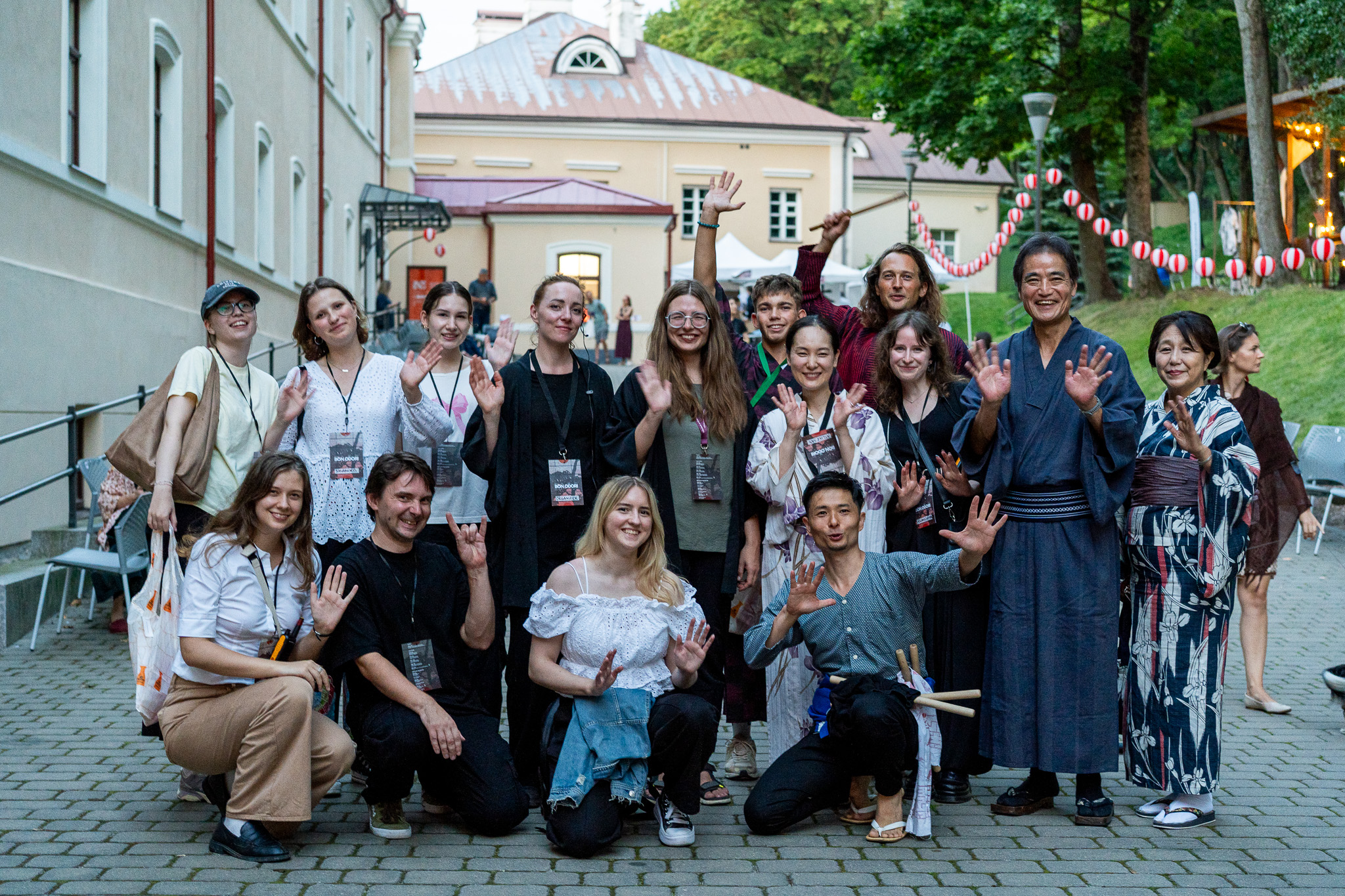
Organisers, guests and volunteers at the Bon Odori festival in Vilnius 2025 pose for a group photograph in front of the House of Histories museum. Photo by Anjė Kanapientyė

The view of London from above at night from the window of a plane Photo by Mikey Kirkpatrick

I can see my house from the plane, in the ochre wake of the setting sun. The two reservoirs where I jogged this the morning flash back up at me; sky-facing eyes that I trace daily along their tree-lined eyebrows and tear-duct streams with my feet. I trace the route with my eyes to Epping Forest, a run I have been planning by looking at maps. We are heading North from London City Airport towards Vilnius, Lithuania, for the second year in a row, to perform at the now annual Bon Odori festival. I’m sat next to Aki, the other half of my Taiko and Flute Duo Zashiki Warashi. He is quietly playing his Shinobue in the darkness of the night flight, the bamboo flute that he plays everyday, learning from scratch since a couple of months ago, with a photocopied handbook in Japanese complete with pictures. We talked about flute playing, resonance, standing waves and Ancient Greek ‘Echeia’ acoustic jars made from clay. Our voices and flute sounds roll alongside the engines of the plane, while our ears pop among the clouds as we sip airline coffee (me) and tea (Aki).

At Vilnius airport we are greeted by the very cool Augis, the Lithuanian partner of Ayano, a dancer and choreographer who is the reason why the Bon Odori Festival began in Vilnius in 2024. Augis drives us to the farm where they live with their daughter Lilija and Arija, their dog. Arija meets our car in the midnight fog and accompanies it safely into its place beneath the stars. Augis built the house from scratch and, when he has time between being a father and touring his theatre shows (he is a Bunraku puppeteer and director, among other things), he installs the newest ‘updates’ to the house, the most recent being some beautiful tiles in the entrance hall where we left our shoes before settling in for Japanese tea and Lithuanian poppy seed cake. We caught up on a year’s worth of stories and they let us hold the new born chicks that came as a surprise to them a couple of weeks ago.
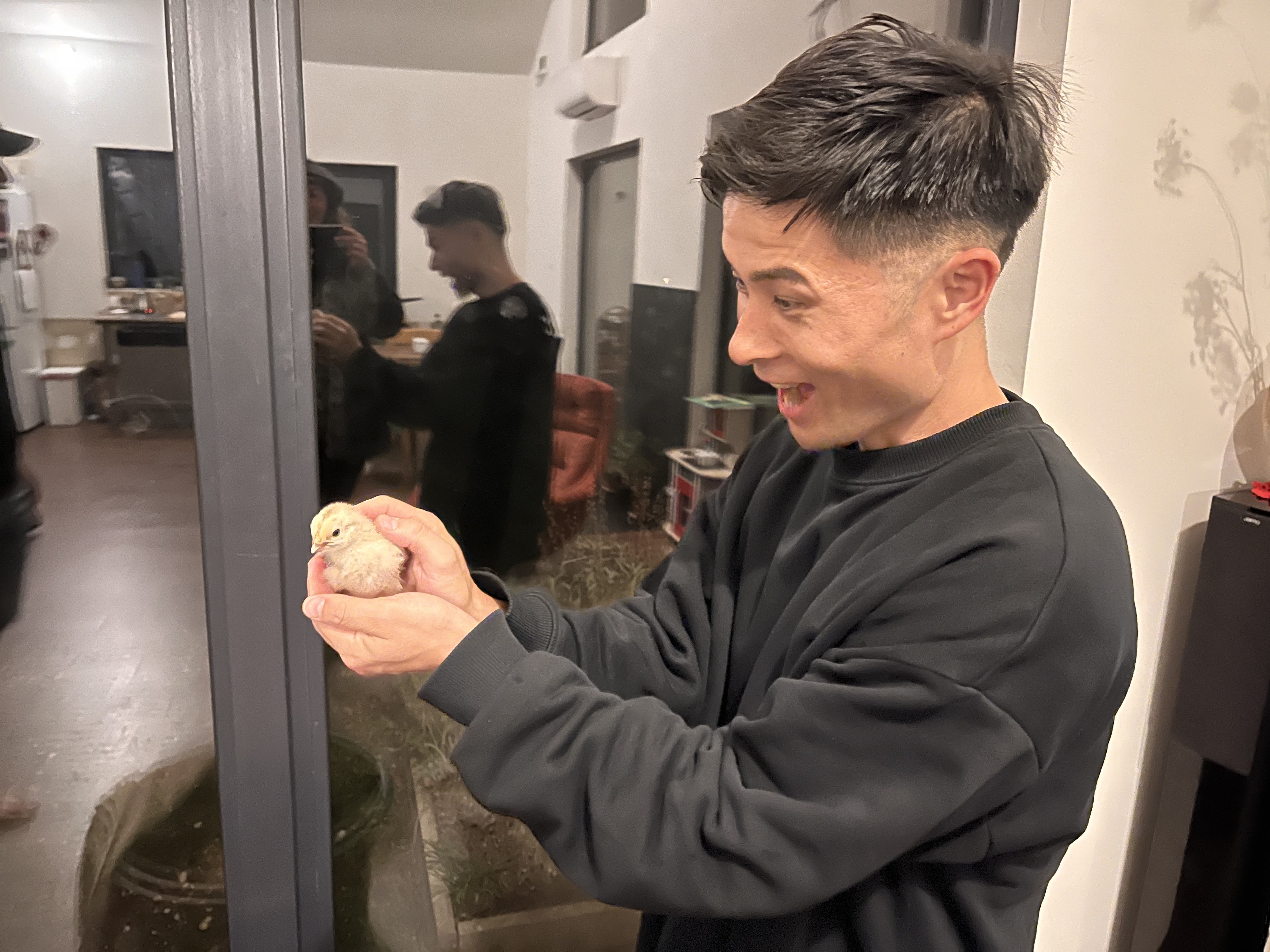
Aki smiling while holding a new born chick in his hands Photo by Mikey Kirkpatrick

After a short sleep I took to the forest paths to tread a new route into my running feet, heading towards a place called Liubavas, a very old royal estate with a watermill and a sculpture of an angel. The sun rising through the low-lingering fog was stunning. I took countless photographs, although every time I stopped in amazement of the light mosquitos gathered all over my legs and started their breakfast, so I was inspired to keep moving. Giant snails, ant hills and flocks of birds lined the way, accompanied with the chirps of grasshoppers in the air. I was lucky enough to glimpse a wild deer, too.
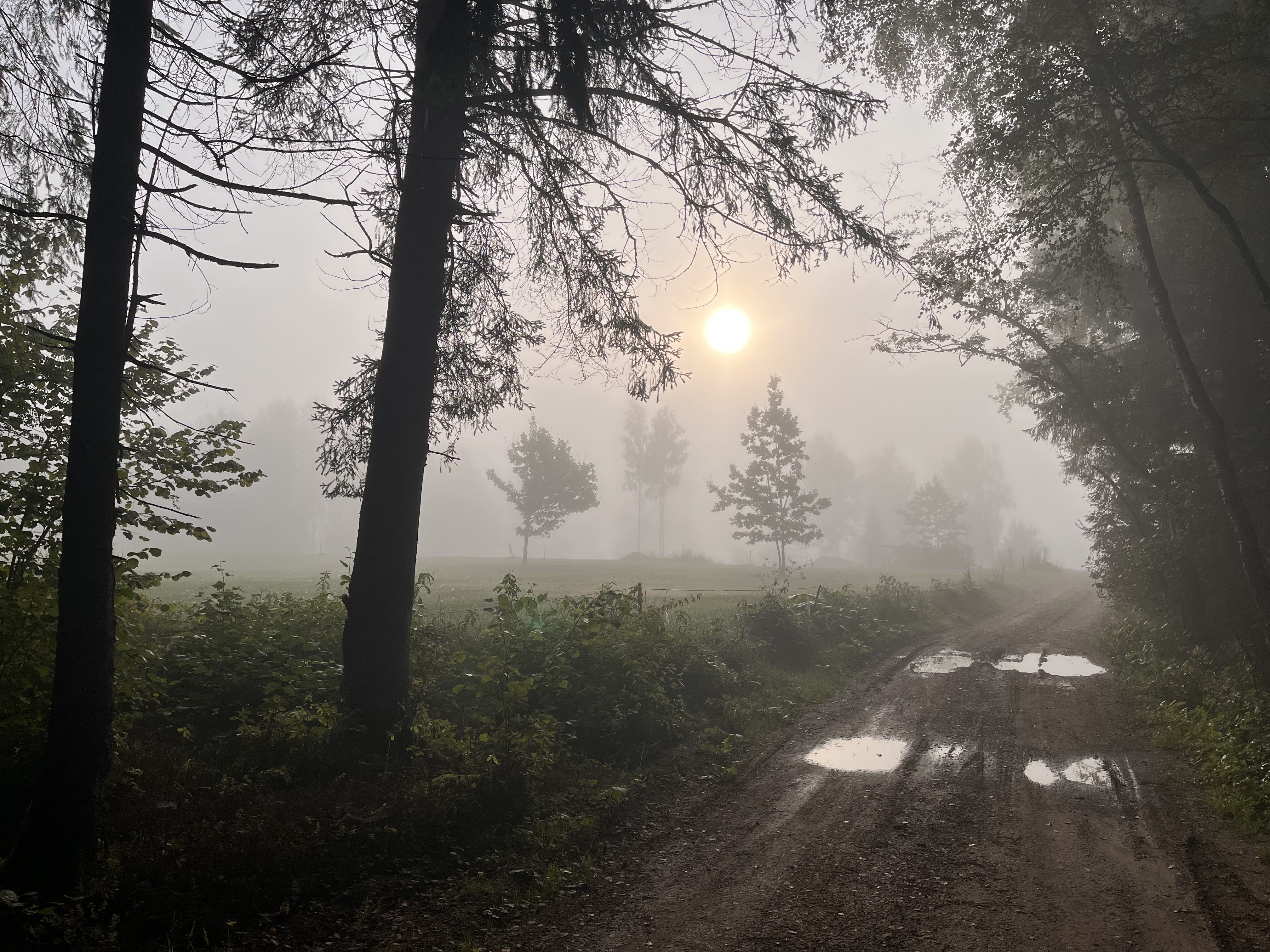
Early morning sun shining through the fog on a woodland path, with pools of rainwater filling the tracks of a tractor Photo by Mikey Kirkpatrick

Coffee, scrambled eggs and home-grown shiitake mushrooms prepared us for a morning of rehearsals outdoors. My shinobue got the forest whispering, at least that’s how it felt as its sound pinballed for miles around. Aki’s small shime drum literally shook the branches of the trees. Woodland neighbours phoned to say they were enjoying our rehearsals from kilometres away. Arija tried her best to get a hold of my bamboo shinobue as it looked like an excellent stick or bone to play with. At one point, while improvising with flute and voice together, I played an open fifth harmony and she ran over to lick my face. It is known as one of the most holy of intervals, and perhaps she felt it. That, or I sounded like a bumblebee. We also filmed an improvisation, thanks to some help from the multi-talented Augis, which we will share soon. Our visit ended too quickly - soon we were in the car and on our way to the city to start our preparations, snacking on homemade Onigiri.
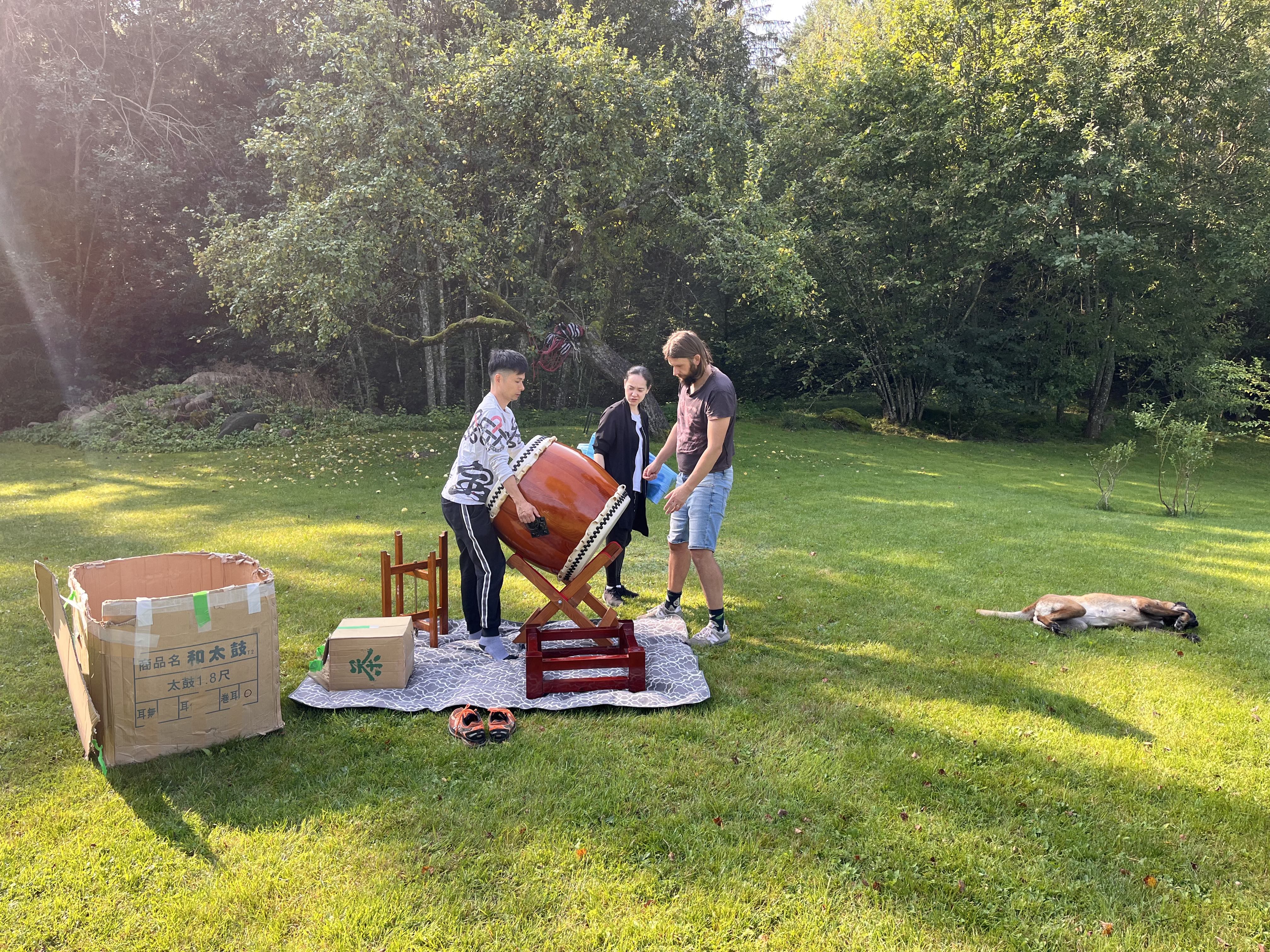
Aki, Augis and Ayano set up a taiko drum on a stand outside on a farm by the woods while Arija the dog lies in the sun Photo by Mikey Kirkpatrick

The Bon Odori festival takes place outside the ‘House of Histories’ museum that celebrates and archives Lithuanian culture and traditions. Augis told us last year that his parents had been in the human chain that stood against the Russian tanks as they tried to return to claim Lithuania, and the resistance won. In 1990, Lithuania declared independence and this was key to the triggering of the dissolution of the Soviet Union. Augis trained as a carpenter, which I expect where his ability to build a house is rooted. Ayano told us how inspiring it is has been for her that Lithuanians have the mentality of doing everything themselves- they are very skilled in working with matter of all kinds. This must come from such a challenging time of endurance, loss and resistance.

Bon Odori is a traditional Japanese festival about opening a portal to the other side, not unlike the day of the dead in Mexico. It is a chance to commune with those we have passed, and those beyond our living memory- our ancestors. In Japan, people gather to circle dance with live music for hours. Ayano has brought this tradition to Lithuania, and it really works. Over 3000 people came for the festival, and many participated in the dance. There is also a similar tradition in Lithuania when people go to light candles in the graveyards, and the traditional Lithuanian dances involve a lot of circles, too. There is clearly a love for Japanese culture in Lithuania too- people dressed in kimonos, enjoyed Japanese food, got involved in martial arts, played Mahjong, and bought lots of Japanese objects and art.

I explored the market stalls before our performance and found the incredible work of Indré, who is also one of the festival organisers. She studied in Japan and makes beautiful paintings on various media, including wood. You can find her work here.
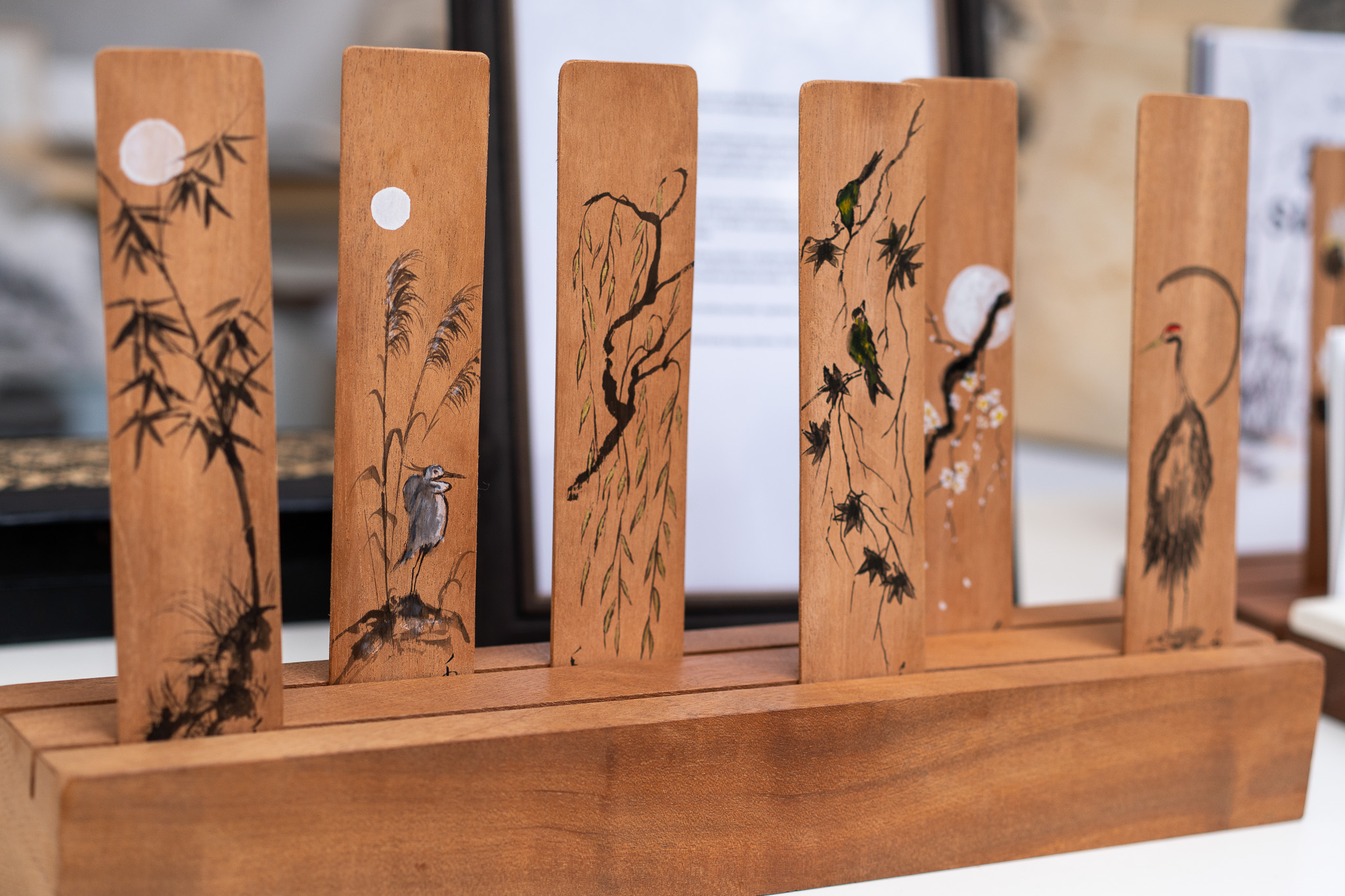
Wooden bookmarks are painted with images of nature, made by the artist Indré Beinarte Photo by Anjė Kanapientyė

For our concert, we performed a version of our show The Rainmaker. We began by weaving through the crowd and onto the stage, singing the opening of our song Wagaya. Pavel, the sound engineer who has his own Sound System (as in Jamaican Sound System and does a lot of street events in Vilnius and keeps the fire burning for the Lithuanian Sound System culture and community) was following our sound with care every step of the way.
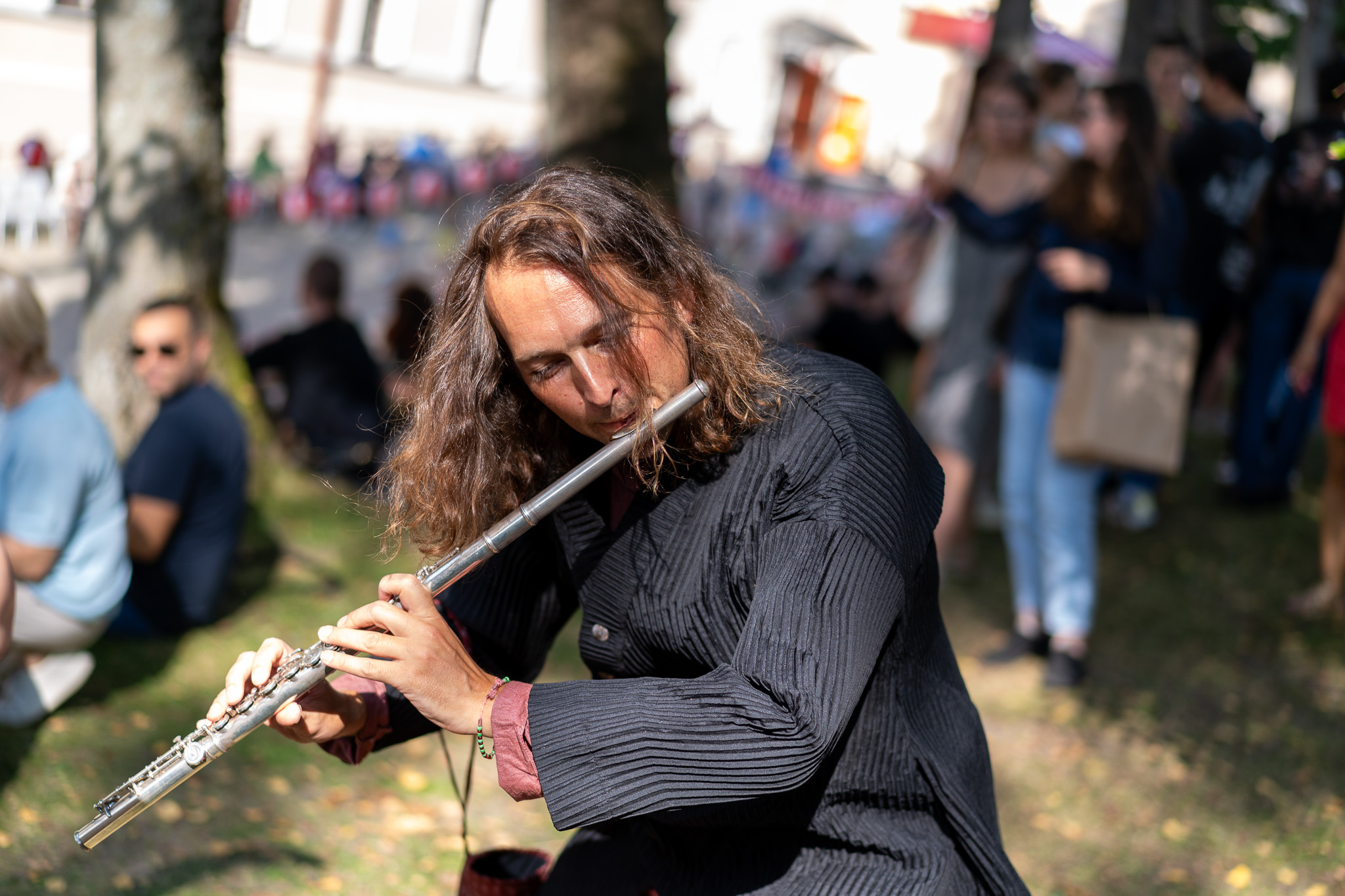
Mikey plays his flute in the crowd Photo by Anjė Kanapientyė

Aki walks down some steps singing, making his way to the stage Photo by Anjė Kanapientyė

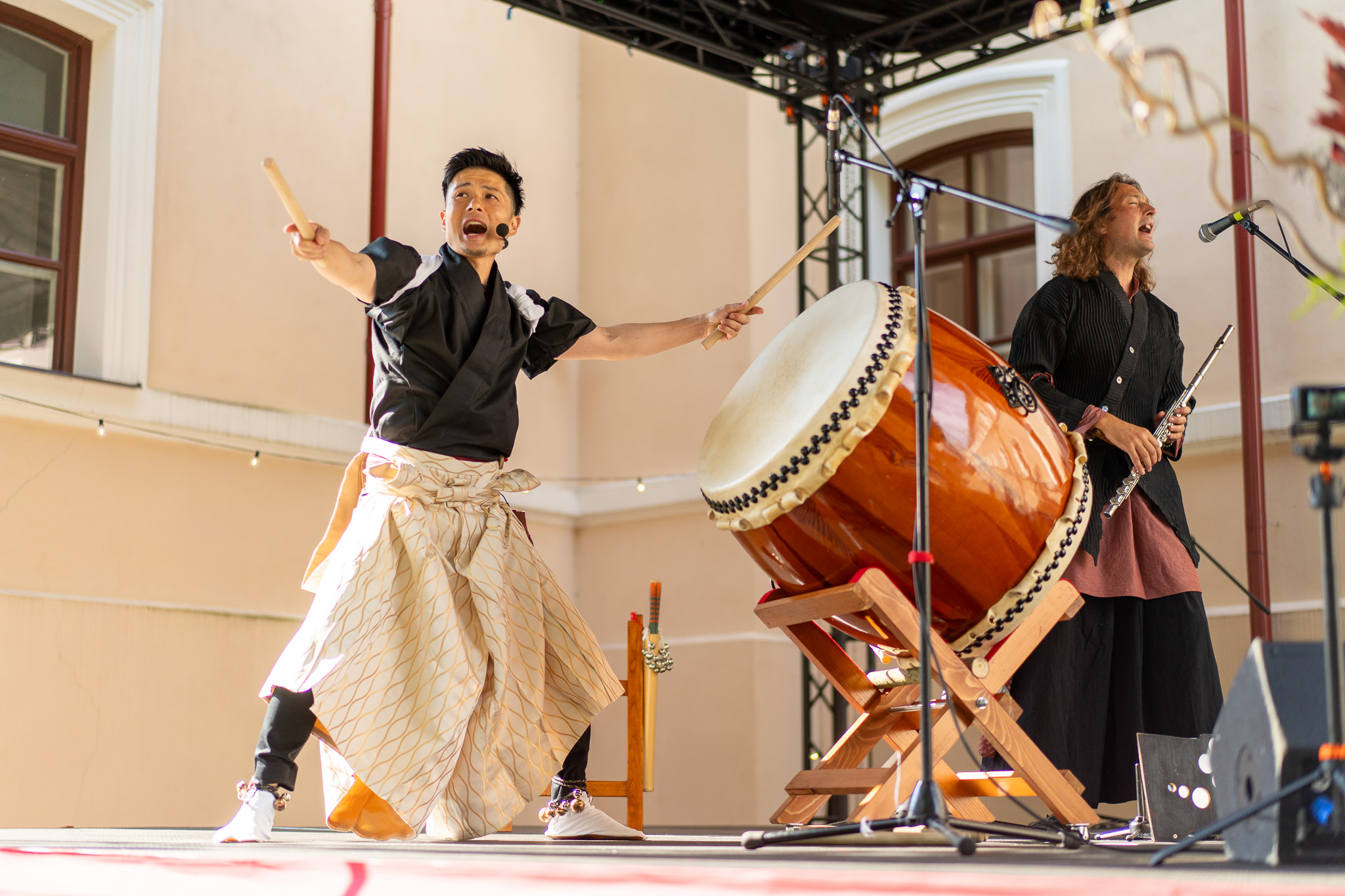
Aki and Mikey dressed in Japanese costumes sing and play drums on stage Photo by Anjė Kanapientyė

A couple of hours later we were on stage for the Bon Dance. Hundreds of people gathered, and as many as the space would allow for learnt each dance with Ayano demonstrating from the stage. Then, we were off. As well as Bon Dance music, we also performed and danced to Ratiliondo, the piece we composed especially for this festival, inspired by Bon Dance and Lithuanian traditional music. During the event, we recorded the crowd shouting out “Ratilio!”, so we can include everyone’s voice on the recording. ‘Ratilio’ is an old Lithuanian word meaning ‘circle’ (this version will be available online shortly). We finished the circle dancing with a ritual; the lighting of 66 candles to open a doorway between worlds. It was beautiful to accompany this with flute and drum; I had shivers down my spine. There was a clear change in the quality of the air.

A crowd of people, many dressed in Japanese clothing, circle dance while guided by Ayano on stage Photo by Simona Kindury.

The following morning, Aki delivered a boiled egg to my hotel room, and I gave him my last tea bag. We packed and headed out to explore the Vilnius Days Festival markets. Among the beautiful amber, metal, bone and wooden objects, tools and sculptures, there were a lot of people working with ceramics. I’m particularly interested in ceramics, especially after having done a beginners course this year and made my first bowl, puppet head and small flute. I found an artist at the market called Beatrice Keleriene whose work had a very special feeling about it. She is also inspired by Japanese culture; she visited Japan and studied the slow firing techniques using an anagama kiln that uses ash as a glaze, and I bought a model of a house from her that was made with this method. She couldn’t come to our concert as she was minding her stall, so I performed an improvisation for her and her work on the street.

After lunch next to a traditional Lithuanian dance performance, we headed towards the airport, but not before Ayano had showed us the Japanese Garden just behind the House of Histories. It has a cherry tree and a river of stones, an incredibly peaceful space to step outside of time. After our goodbyes we were sat on the plane again listening back to the recordings from the weekend. Aki pulled out a twin banana that Ayano had given him over the weekend: two bananas joined together inside the same skin. Aki, who has twin boys, couldn’t believe the chance of it!
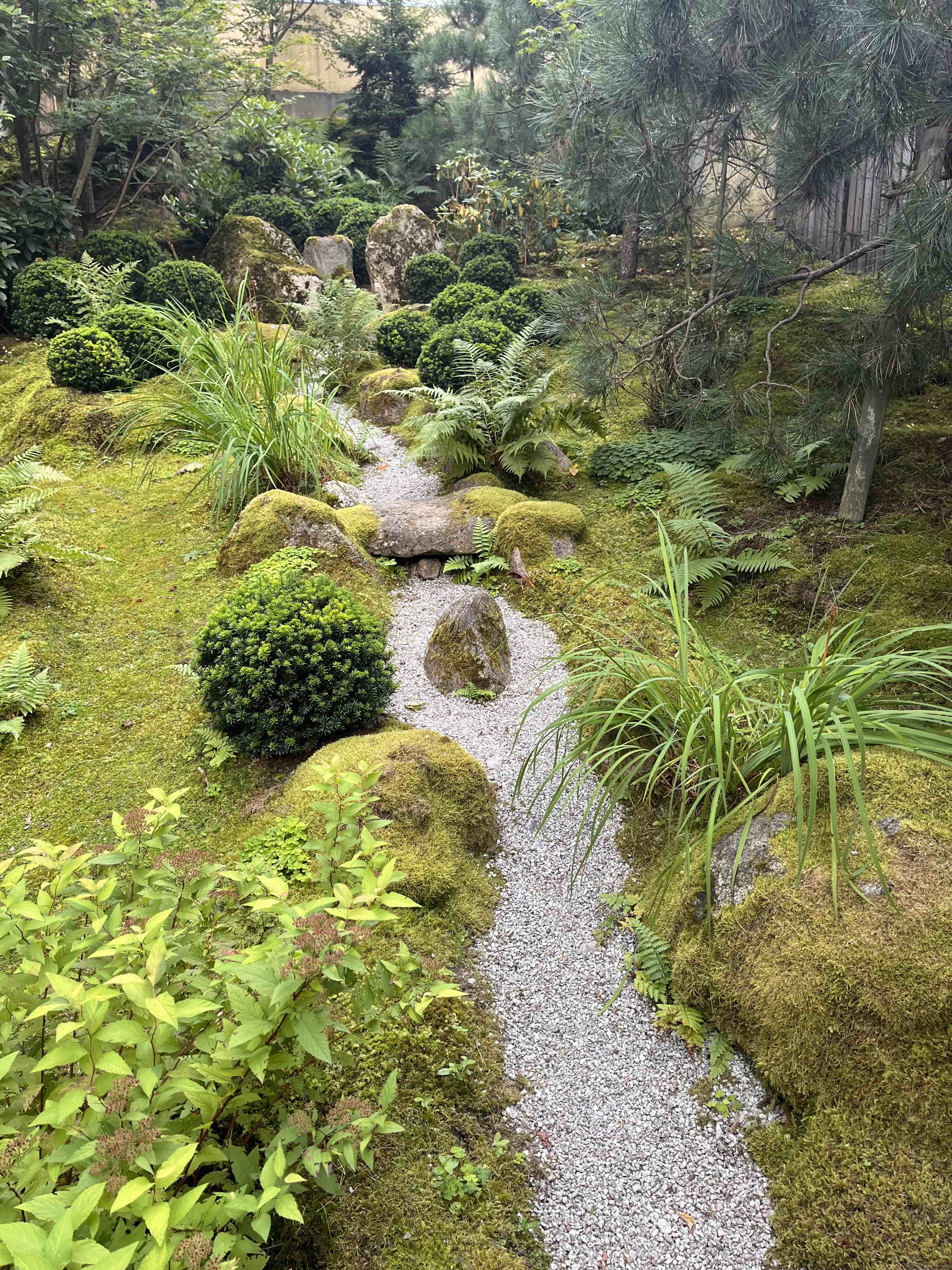
River of Stones in a Japanese garden in Vilnius Photo by Mikey Kirkpatrick

When you’re learning an instrument, you don’t necessarily think about where it might take you, and who you might meet, both in your imagination and out in the world. So play, and see what adventures unfold before you. You might just meet yourself on that path too.

Thank you to everyone at the Bon Odori festival. We hope to see you again next year!

A dancer stands with her back to the camera, her right arm raised as though carrying something. She is wearing a kimono, and tucked into her belt is a fan that shows the name and logo of the Bon Odori festival Photo by Anjė Kanapientyė

The Witch’s Broom / The Flying Flute / The Enchanted Drum Nov 20, 2024

image description

Often, when I change the sheets of the bed, I listen to the sound of the fabric as it flaps and rises into the air, as I brush the creases out with my hands and tuck it under the mattress. Then, the drumming and plumping of the pillows, the wrestling and shaking of the duvet into its cover. It is an old dance, this one. We’ve all done it. The smell of soap and softener. The agitated air. Dust particles in the light. I change my daughters bed sheets, too, moving her soft toys out of the way then lining them up again, her favourite ones by the pillow, the rest at the foot of the bed. I hand wash the hand-dyed clothes I wear from Kiraku, turning the cold water deep blue, wringing them out and hanging them to drip dry. Then there’s the dustpan and brush, because the hoover doesn’t really work anymore. I enjoy the simplicity of it all, and try to be with all of these actions, and nowhere else, which isn’t always easy. I do the same when playing the flute.

These rituals of the home place my hands into those of my mother, grandmother and beyond. I remember watching it happen around me when I was small and unable to participate, like with the stove in the kitchen. I always played ‘home’ and took it seriously, preparing bowls of dry pasta for my family to pretend to eat. Later, I had my own kettle with bags of smokey Lapsang Souchong and sweetened Ginseng tea in my teenage bedroom, where I read books and performed my own naive tea ceremonies alone in rural England. We are bound by these transformative acts, gestures that echo through generations of home makers, across time, space, culture and language.

I can understand why the broom would be the witch’s choice for flying instrument. I think of flying because I am flying as I write this to Luxembourg to perform as Zashiki Warashi with Akinori Fujimoto. We met at dawn today like ancestral brothers at the airport. We share a suitcase filled with costume that we have ironed and folded at our respective homes, leaving for our journey while our families sleep. It is my flute and Aki’s drums that fly us into new places, real and imagined. As we play, we transport ourselves and audiences together.

And, as with changing the sheets, we leave the air shaken, some dusty clouds dissipated. We are doing the housework, home-making, and taking care of what is important to us, as people always have, and always will. Using what we have to hand, we cast our spells and ride our witch’s broom into the vast skies, continuing to shake the sheets, preparing for a new day, no matter how turbulent the times.

image description

Subscribe to Zashiki Warashi on YouTube for live footage and behind the scenes videos and follow us on Instagram.

This was written by Mikey Kirkpatrick on Wednesday 20th November 2024 en-route to Luxembourg to perform at the Rainy Days Festival.

Zashiki Warashi perform at Lithuania's first Bon Odori Festival Sep 10, 2024

Photo by Agnė Kanapienytė On 7th September 2024, Zashiki Warashi performed at the first Obon festival including a Bon Odori dance celebration in Vilnius, Lithuania, organised by our dear friend, Ayano Honda with Gabija Vosyliute & Indré Beinarté of Asian Arts Centre Vilnius, and Haruka Seto, Agne Andriuskaite, and Sachiyo Watanabe of the Japanese Embassy. The event took place on the beautiful grounds of the House of Histories - the National Museum of Lithuania. We performed Ichiban Daiko, Komoriuta (Lullaby), Seiten and Shogun, and ran a workshop, demonstrating our instruments and talking about the pieces we played, as well as giving the audience a chance to learn a Bon Dance rhythm, and play the taiko, guided by Aki, and accompanied by Mikey on the Shinobue flute. Photo by Agnė Kanapienytė

Ayano Honda, who is from Japan but lives in Vilnius, saw that the All Soul’s Day celebrations in Vilnius resonated with the 500 year old Japanese Obon tradition, a day when people honour the spirits of their ancestors. The Bon Odori, or Bon Dance, is a circle dance that takes place around a stage where musicians perform famous Bon Dance music (such as Tokyo Ondo) while a dancer demonstrates the movements, which is what happened at Vilnius’ first ever Bon Odori. Ayano taught the dances at a workshop during the day. A full crowd came to the festival (nearly 3000 people throughout the day) and many joined the circle dance, or danced on the spot while watching from the sides. We also premiered Ratiliondo, an original Bon Dance piece that we composed especially for the occasion, inspired by the Bon Odori custom along with traditional Lithuanian vocal folk music. Ayano choreographed a dance for the piece, movements that symbolise work (cutting grass), the passing of time, dancing, and passing its values down through generations. Photo by Agnė Kanapienytė

Performing this piece with many dancers circling the stage was a very special moment, which was followed by an overwhelmingly beautiful scene of everyone holding hands at Okuribi ceremony for which we played our instruments to send the spirits of our ancestors off. The Japanese Ambassador of Lithuania, Mr Tetsu Ozaki joined the celebration and gave a speech, and also led the closing Sanbon-jime, a rhythmic clapping that everyone traditionally performs together in Japan to mark the closing of special celebrations and ceremonies. Rasa, who hosted the evening’s celebration, told the crowd “see you next year”, and judging by the success of the festival, we feel confident that Vilnius’ Obon Festival will happen again in 2025. Thank you to everyone who made the event possible, and a special thanks to Pavel who did an incredible job with the sound, and to Ayano for inviting Zashiki Warashi to be part of this beautiful event. We hope that people will dancing to Ratiliondo for the next 500 years!

All photos by Agnė Kanapienytė.

Photo by Agnė Kanapienytė

A Thank You, and a New Stop Motion Photo Animation of The Rainmaker at The Old Church, Hackney Jul 29, 2024

On 16th March 2024 many of you came and filled up The Old Church, Hackney, London, for our show 'The Rainmaker'. The Old Church, Hackney is the only surviving Elizabethan church in London. It has a beautiful acoustic and atmosphere, one that gave us great pleasure to conjure up the sounds of our show, casting shadows across the old stone walls so that all of us there that night have become part of the church’s story. Regardless of our beliefs, a place of prayer is a space for bridging over from what we can see to what we can’t, a call through the mist for some help, some care, some support from the other side, or to show gratitude to that which is bigger than us. Our music, and this show, is inspired by our histories and mythologies, old and recent, both real and imagined, from the Celtic Druids and ancient Shintos, and the world we create with our melodies, rhythms and songs. The video above is a stop motion photo animation video made by Chiara Ambrosio, who also took the photos that you see on this post, featuring live audio from that night of our piece 'Hessy', a wonderful memory of the night and a glimpse into the mood of 'The Rainmaker' show.

Zashiki Warashi performing The Rainmaker live at The Old Church on 16th March 2024. Photo by Chiara Ambrosio

Something happened that night. There was a chemistry. The show sold out, the congregation was full, and we played and sang out to the other side. We saw the church transform. All of us became mountains, sea, forest, earth and sky. It was a voyage, from building the stage and setting up our taiko and flutes, right through to speaking with many of you after the show, packing up the chairs and closing the church door again, leaving our music, our presences, yours included, soaring out into the cosmos, recorded in those Elizabethan bricks.

Zashiki Warashi performing The Rainmaker live at The Old Church on 16th March 2024. Photo by Chiara Ambrosio.

Thank you to Deirdre at The Old Church for making it possible. Thank you to Chiara for taking the pictures and making this film to remember the night, to Nao for the lights, and to Alma Luz for recording the announcement for the beginning of the show as Zashiki Warashi. And most of all, thank you all for coming. We look forward to seeing you at the next show.

Zashiki Warashi performing The Rainmaker live at The Old Church on 16th March 2024. Photo by Chiara Ambrosio.

New Video Up on YouTube #1 Apr 25, 2024

We have a few new YouTube videos coming for you and the first one is now uploaded.

Our latest composition "Seiten" live at Yokimono Japanese Christmas Market back in December 2023, filmed by Azulible. We started off playing here with Ichiban Daiko, which is a short drumming traditionally played early mornings to let people know that the Kabuki Theatre show is on today. The rhythm used here, "don don don to koi" in Japanese language, is a phrase that encourages people to come. We like to start off with Ichiban Daiko to encourage people to come, inviting people in for those events.

Playing at Yokimono Japanese Christmas Market at the Factory in Dalston, London is becoming a lovely tradition for us. As usual, the place was packed with full of people enjoying the food stalls and shops at the market and we had a great time performing 2 short sets for the people there.

Thanks to Sonoe from Furuki Yokimono vintage Kimono store for inviting us again.

Mailing List

By signing up you agree to receive news and offers from Zashiki Warashi. You can unsubscribe at any time. For more details see the privacy policy.