The Bottle Decides the Filler: A Container-First Guide to Liquid Filling
Product businesses choose their bottles for the shelf. Shape, colour, feel in the hand, how it photographs. All fair, all commercially sensible, and all decided months before anyone asks the question that determines whether production runs smoothly for the next five years: how does this container actually behave on a filling line?
Because here is the thing equipment suppliers learn early and founders learn late. The product decides the filling technology, but the bottle decides almost everything else: the nozzle, the handling, the speed, the changeover time and a good share of the cost. If you are specifying equipment, or better, if you are still choosing packaging, here is the container-first view of bottle filling that saves the most grief.
Start with the neck, not the volume
The neck opening is the single most consequential dimension on the bottle. It sets the maximum nozzle diameter, and nozzle diameter sets fill speed for any given product. A wide-mouth jar fills fast and forgivingly; an 18 millimetre spirit bottle neck or a narrow dropper bottle forces a slender nozzle, slower flow, and more care with splash.
Necks also decide whether bottom-up filling is available to you. For foaming products, shampoos, detergents, kombucha, anything with surfactants, the nozzle needs to descend inside the container and retract as it fills, keeping the outlet below the liquid surface. That requires a neck the nozzle can enter cleanly. Choose a beautiful bottle with an awkward neck and you may have designed away the one technique that handles your foaming product properly.
While you are there, ask about the shut-off. A positive shut-off nozzle closes the flow decisively at the end of each cycle rather than letting the last of the product string or drip, which is the difference between clean shoulders on the bottle and a shift spent wiping.
Level or volume: what should "full" mean?
This is a genuinely underrated decision. Volumetric filling delivers the same measured volume into every container, which is what trade measurement cares about and what your margin depends on. But glass varies slightly from bottle to bottle, so identical volumes can sit at fractionally different heights, and on a clear glass product like gin, the eye reads a shelf of varying fill lines as inconsistency even when every bottle is legally perfect.
There are approaches for each priority, and the right answer depends on your container and your category. Opaque bottle, HDPE jug or squat jar: volume is all that matters. Clear tall glass in a premium category: the visual fill line matters commercially. A supplier should ask which one you are optimising for; if the question never comes up, it was answered for you by default.
The product still gets a vote
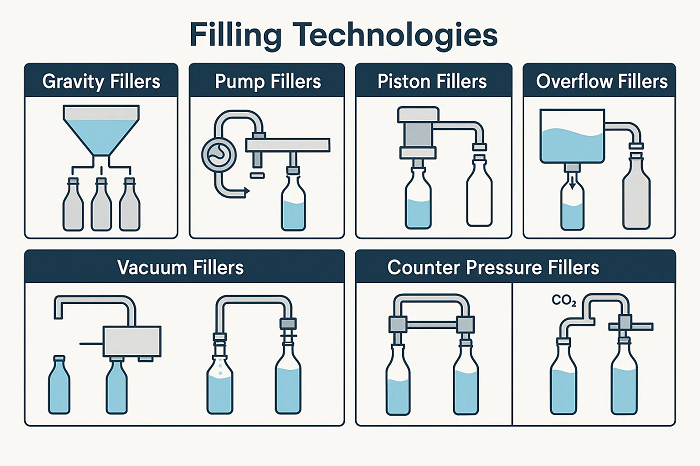
None of this displaces the viscosity conversation. Thin, free-flowing liquids suit gravity filling, thick or particulate products want a piston, and the awkward middle is where pressure and vacuum approaches earn their place. Hot-fill products bring their own requirement: anything filled above 65 degrees, sauces, jams, some juices, needs equipment specified for hot product handling from the outset, not adapted afterwards.
The point of the container-first framing is that the bottle constrains which of these technologies you can actually deploy, and how fast. The same sauce fills very differently into a wide jar versus a squeeze bottle with a 20 millimetre neck, and the honest way to resolve it is a trial: any serious supplier of a liquid filler machine will run your actual product into your actual containers before you commit, because that single test settles nozzle size, fill speed and splash behaviour in an afternoon.
Plan for the bottles you will run, not the one you launch with
Almost nobody stays a one-bottle business. The 250ml launches, then retail wants a 500ml, then food service wants a 2 litre, and suddenly the filler is changing over between formats weekly.
Two specification details decide whether that future is painless. First, fill capacity range: a machine with a 3 litre product cylinder covers most retail formats in one stroke, while larger 5 litre configurations extend into bulk formats. Buying with your two-year packaging roadmap in mind costs little now and saves a machine replacement later. Second, changeover design: tool-free adjustment and cleaning means format changes happen in minutes with no technician, which is the difference between running small batches economically and dreading them. Ask to watch a changeover during the demo, timed, not described.
Bottle stability matters here too. Tall, narrow or oddly footed bottles that wobble need more support on the line, and the time to discover that is at the trial, not the first production run.
The one-line summary for packaging decisions
If the packaging is still being chosen: get the filling equipment conversation happening before the bottle is locked, because a small change to a neck size or shoulder can remove an expensive constraint for the life of the product. If the bottle is already fixed: bring it, and the product, to the equipment trial and let the combination be tested rather than assumed. Either way, the container is not just what the customer holds. It is the specification document for half your production line.
Packserv designs and manufactures pneumatic filling equipment at its Sydney facility, with technical support across Sydney, Melbourne, Brisbane, Adelaide and Perth, and has supplied Australian manufacturers since 2007. Their liquid filling machine range spans single-head bench top units through multi-head automatic systems, with product trials available before purchase and every machine offered to buy, rent or rent-to-buy.